The .50 BMG has been an American cartridge for more than a century. Designed for John Browning's machine gun, and today it fills the safes of long-range shooters, collectors and competitors from coast to coast. Even so, rifles chambered for it have been a favorite target of gun control politicians for more than twenty years.
Here is where the law stands today, what is being pushed right now, and why we think every gun owner in a free state should pay attention.
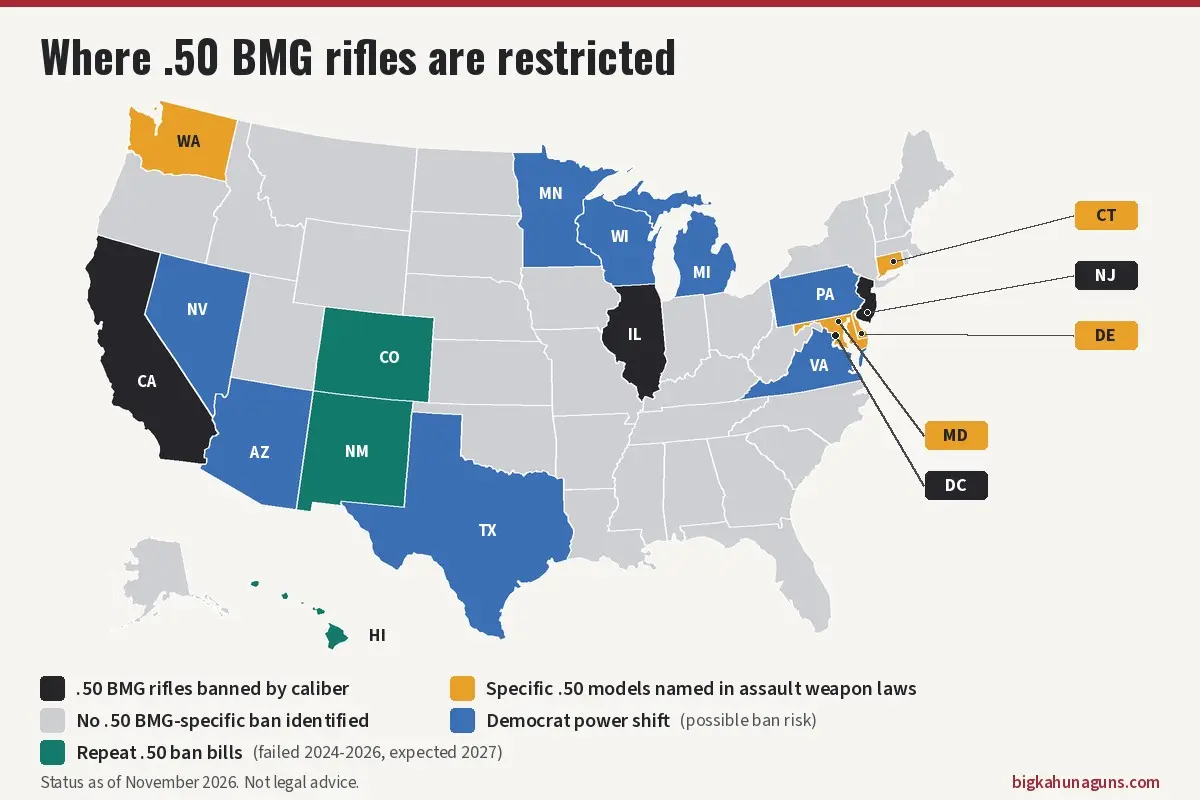
.50 BMG Rifles Are Already Banned in a Few States
California went first. Its .50 BMG Rifle Regulation Act took effect in 2005 and outlawed making, selling, importing or lending a centerfire rifle that can fire the .50 BMG cartridge. Owners could keep a rifle they already had only if they registered it with the state by April 30, 2006. After that, the door closed. Registered rifles can only be kept in certain places and cannot be sold to another Californian.
Washington, D.C. will not register a .50 BMG rifle at all. Since the city requires every firearm to be registered, that is a complete ban.
New Jersey treats any centerfire rifle that can fire a .50 BMG cartridge as a "destructive device," the same legal category as explosives.
Illinois added .50 caliber rifles and .50 caliber cartridges to its Protect Illinois Communities Act in January 2023. New sales stopped right away. People who already owned a rifle had to file an endorsement affidavit with the Illinois State Police, and possession without one became a crime on January 1, 2024. Even having a few 50 BMG rounds is a Class A misdemeanor (up to 364 days in jail and a fine of up to $2,500
Other states go after certain models by name. Connecticut, Delaware, Maryland, Minnesota and Washington all list semi-automatic Barrett .50 rifles in their assault weapon laws. Those laws target models, not the caliber, but they show how fast a list can grow.
Notice the pattern. California and Illinois let existing owners keep their rifles, with paperwork and limits, and shut out everyone who waited. D.C. did not even do that.
States that keep trying
New Mexico, Hawaii and Colorado keep trying to restrict .50 caliber rifles. Those bills failed, but Democrats hold more seats in each legislature, and the same ideas are likely to return in January 2027.
In New Mexico, SB 279 died in the Senate in 2025. SB 17 passed the Senate on February 7, 2026, and was postponed indefinitely in the House on February 12. It would have barred dealer sales of .50 caliber rifles and cartridges starting July 1, 2026, though the text exempted bolt-action rifles. That is a reading of the bill, not a court ruling. House Democrats flipped four Republican seats and now hold 47 of 70, a two-thirds supermajority. The Senate stays at 26 to 16.
Hawaii has filed .50 caliber bills since at least 2006. SB 600, HB 893 and SB 2734 all died when the 2026 session ended on May 8. SB 2734 would have banned firearms that can fire .50 caliber or larger after July 1, 2026, except guns already owned. Democrats control both chambers and now hold 44 of 51 House seats and 22 of 25 Senate seats.
Colorado tried in 2024, when HB 24-1292 treated .50 caliber rifles as assault weapons. It passed the House and was postponed indefinitely in the Senate that May. No similar bill appeared in 2025 or 2026. Democrats now have their first supermajorities: 24 to 11 in the Senate and a House majority over the 44-seat two-thirds line. A similar bill would have a clearer path in 2027.
What Is Being Pushed Right Now
In February 2025, Senator Dick Durbin and Representative Joaquin Castro introduced the Stop Arming Cartels Act of 2025 (S. 367 and H.R. 923). It would make it a federal crime to import, sell, make, transfer or possess any rifle capable of firing .50 caliber ammunition. Rifles already owned would be grandfathered, but every one of them would have to be registered with the federal government under the National Firearms Act within twelve months.
As of this writing, both bills sit in committee and have not moved. But a bill like this does not have to pass this year to matter. It is a template, ready for a different Congress.
The states are moving too. In 2026, New Mexico's SB 17 would have banned .50 caliber rifles along with common semi-automatic firearms. It passed the state Senate and died in the House when the session ended. Virginia passed a broad semi-automatic ban in 2026 that is blocked in court for now.
The Courts Will Decide a Lot

The Supreme Court's 2022 Bruen decision said gun laws must fit the nation's history and tradition of firearm regulation. A packed Supreme Court may reverse it though.
In July 2026, a divided Seventh Circuit panel reversed a lower court and upheld the Illinois ban. That ruling focused on AR-15s and magazines, not .50 caliber rifles. The Supreme Court has now agreed to hear two AR-15 ban cases, Viramontes v. Cook County and Grant v. Higgins, with arguments set for December 2, 2026. How the Court rules on what counts as a protected, commonly owned firearm will shape the fight over every banned category, including the .50.
Nobody can promise how that turns out. A good ruling could roll back bans. A bad one could invite more.
Even Free States Are Already Regulated

The .50 BMG is not a mail-order item anywhere. In 2018, ATF letters made clear that bolt-action .50 BMG uppers like ours are treated as the receiver, so they are serialized and must go through a licensed dealer with a background check. Buyers must be 21 or older.
If You Have Been Thinking About One
The lesson from California, Illinois and New Jersey is simple. When a ban arrives, the people who already own one are usually allowed to keep it. The people who waited are not.

If you live in a free state and have been thinking about a .50 BMG, now is a good time to make that decision while the choice is still yours. Our Raptor 50 is a single-shot, bolt-action .50 BMG upper built here in Odessa, Florida, and it fits a standard AR-15 lower. You can see it here: Raptor 50 .50 BMG AR-15 Upper.
The Raptor 50 ships to your FFL dealer, and you must be 21 or older. Big Kahuna Guns does not ship .50 BMG to California, New Jersey, Connecticut, Illinois or Washington, D.C.
Stand With the Groups Fighting for the Second Amendment

Buying a rifle protects your own rights. Joining a gun rights group helps protect everyone's. These four organizations are in the fight every day, in Congress, in statehouses and in court:
- Gun Owners of America (GOA) calls itself the no-compromise gun lobby and is among the plaintiffs in the Illinois case now seeking Supreme Court review. gunowners.org
- Firearms Policy Coalition (FPC) brings Second Amendment lawsuits nationwide and is also a plaintiff in the Illinois case. firearmspolicy.org
- National Association for Gun Rights (NAGR) lobbies against gun control at the state and federal level and tracks bills like New Mexico's. gunrights.org
- National Rifle Association (NRA) is the oldest of the four, lobbying through NRA-ILA and running training programs nationwide. nra.org and nraila.org
Pick one or pick all four. Become a member, donate, sign up for their alerts and call your representatives when a bill comes up. Laws like these pass when gun owners stay quiet.
From all of us at Big Kahuna Guns, thank you for standing up for the Second Amendment.
This post is for general information and is not legal advice. Gun laws change often. Check your state and local laws, and talk with your FFL dealer, before you buy.